
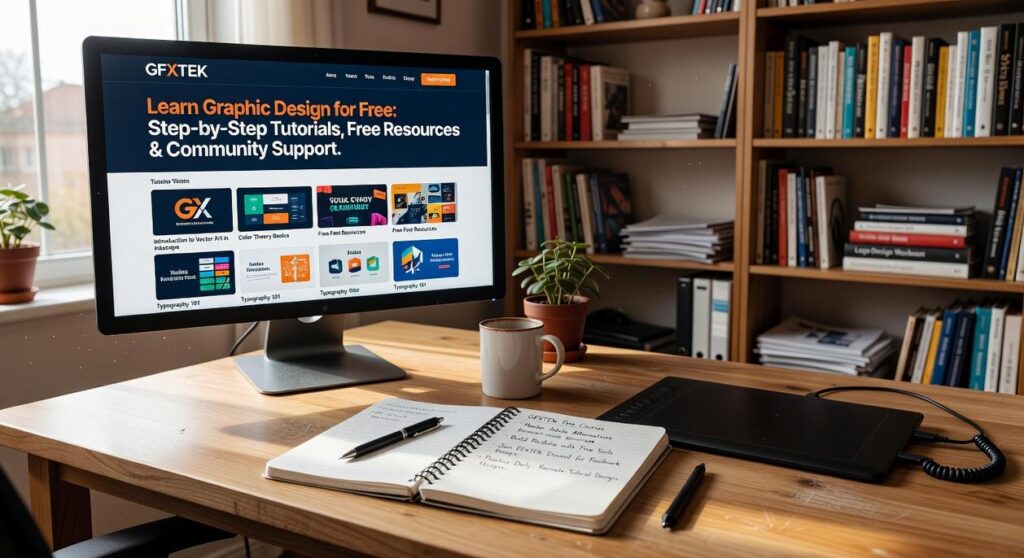
I know what’s stopping you from learning graphic design.
It’s the price tag. Courses cost hundreds of dollars. Software subscriptions add up fast. And you’re not even sure if design is your thing yet.
You shouldn’t have to pay to figure that out.
I’ve put together a complete path to learning how to learn graphic design for free gfxtek using resources that are already available right here. No paywalls. No trial periods that expire when you’re halfway through.
This article walks you through everything you need to go from zero experience to having real work in your portfolio.
We’ve tested these methods with beginners. We know what works and what wastes your time. The tutorials I’m pointing you to are the same ones that helped people land their first design clients.
You’ll get a step by step roadmap. Which tools to start with. Which skills to build first. How to practice without feeling lost.
By the end, you’ll have a clear path forward and the confidence to actually start creating.
No credit card required.
Step 1: Master the Fundamentals with GFXtek’s Core Concepts Series
Look, I’ll be honest with you.
When I started learning design, I thought it was all about knowing Photoshop. Get good at the tools and you’re set, right?
Wrong.
I wasted months creating stuff that looked technically fine but felt off. The colors clashed in ways I couldn’t explain. My text was readable but boring. My layouts felt cramped even though I had plenty of space.
That’s when I realized something. Software is just the vehicle. The principles are what actually matter.
And here’s where I need to be straight with you. Some designers will tell you that theory is outdated or that you should just learn by doing. They say formal principles restrict creativity.
I’ve gone back and forth on this myself. There are times when breaking the rules creates something amazing. But here’s what I keep coming back to.
You need to know the rules before you can break them effectively.
The problem is figuring out which principles actually matter. There’s so much conflicting advice out there that it gets overwhelming fast.
What I’ve found is that three areas form the real foundation.
Color theory teaches you why certain palettes work together and others don’t. You’ll learn about contrast and how colors affect people psychologically (though I’ll admit the psychology part is still debated among experts).
Typography is trickier than it looks. Pairing fonts, creating hierarchy, making text readable without being boring. This one took me the longest to grasp.
Layout and composition is about balance and visual flow. Where your eye goes first, how white space actually works, why some designs feel right and others don’t.
Now, I’m not going to pretend I have all the answers here. Design principles evolve and what works in one context might fail in another. But these fundamentals give you a starting point.
If you want to how to learn graphic design for free Gfxtek, begin with the core concepts. Start with the Graphic Design Principles for Beginners guide and work through it slowly.
Don’t rush this part. I did, and I paid for it later.
Step 2: Your Free Toolkit—The Best No-Cost Design Software
You don’t need expensive software to create professional work.
I know that sounds like something everyone says. But I mean it.
The tools I’m about to show you are the same ones professionals use when they’re starting projects or working on personal stuff. They’re free and they’re good.
Let me break down what you actually need.
For photo editing and digital painting, you’ve got two solid options. GIMP gives you desktop power with layers, masks, and filters that rival paid software. Photopea runs in your browser so you don’t have to install anything (perfect if you’re on a work computer or just want to test things out). For gamers looking to enhance their creative skills, Gfxtek offers a wealth of resources that complement both GIMP and Photopea, making it easier than ever to bring your digital art to life.
Both handle raster graphics. That’s anything made of pixels like photos or painted artwork.
If you go with GIMP, I’ve put together a beginner series that walks you through the interface. It’s not the prettiest program but once you know where things are, it works great.
For logos and illustrations, you need vector software. That’s graphics built from mathematical points instead of pixels, which means they scale to any size without getting blurry.
Inkscape is your desktop option here. It’s open source and handles everything from simple icons to complex illustrations. Figma’s free tier is the other choice and it’s cloud based, which makes collaboration easier if you’re working with others.
Our Vector Art Fundamentals guide covers the basics of both. The concepts transfer between programs so you’re not locked into one choice.
For social media graphics and quick layouts, Canva wins. It’s template based which some designers hate, but templates are exactly what you need when you’re learning. You can see what works and then modify it.
I wrote up 10 Canva tricks that’ll make your stuff look way more polished. Small things like proper spacing and font pairing make a huge difference.
Now here’s the comparison that matters.
GIMP vs Photopea? Pick GIMP if you want more control and don’t mind a learning curve. Pick Photopea if you want something familiar that works right now.
Inkscape vs Figma? Inkscape if you’re working solo and want full offline access. Figma if you value modern interfaces and might collaborate later.
Getting started is straightforward. GFXtek has installation guides for each of these programs. I made them simple because nobody wants to spend an hour just getting software running.
Download what sounds right for your first project. You can always add more tools later.
That’s how to learn graphic design for free gfxtek style. Start with one program, get comfortable, then expand.
Step 3: From Theory to Practice—Follow GFXtek’s Project-Based Tutorials
Here’s where most beginners mess up. If this resonates with you, I dig deeper into it in Gfxtek Graphics Design Guide From Gfxmaker.
They watch tutorial after tutorial. They bookmark dozens of videos. They read every article about design principles.
And they never actually make anything.
I see this all the time. People think they need to understand everything before they start. They want the perfect foundation before touching any software.
That’s backwards.
You learn faster by doing. Not by watching someone else do it.
I know that sounds scary. You’re worried about making mistakes or creating something that looks terrible. But here’s what nobody tells you: your first projects are supposed to look bad.
That’s the point.
The Projects That Actually Matter
I’ve put together a sequence that works. Four projects that build on each other without overwhelming you.
Project 1: Your First Logo
Start with something simple. A logo forces you to think about shapes and composition without getting lost in details. Use Inkscape or Figma and follow the best graphic design courses gfxtek tutorial on basic logo creation. To master logo design, consider utilizing tools like Inkscape or Figma while referring to the comprehensive Graphics Software Guide Gfxtek for invaluable insights into shapes and composition.
Don’t try to be original yet. Just follow along exactly.
Project 2: A Professional Social Media Post
Now you’ll work with text and images together. This teaches you hierarchy and balance. The Canva or GIMP tutorial walks you through it step by step.
(This is where things start clicking for most people.)
Project 3: A Simple Business Card Layout
Smaller canvas. Tighter constraints. You’ll learn why white space matters and how alignment changes everything.
Project 4: Photo Retouching Basics
By now you’re ready to work with photos. Basic retouching shows you how small adjustments make big differences.
Here’s the thing about how to learn graphic design for free gfxtek style.
Copy first. Experiment later.
I know that feels wrong. Everyone says “be creative” and “find your voice.” But you can’t break rules you don’t understand yet.
Follow these tutorials exactly as they’re shown. Then go back and change one thing. See what happens. Change another thing.
That’s how you actually learn.
Step 4: Build and Showcase Your Portfolio for Free
Here’s what everyone gets wrong about portfolios.
They tell you to wait until you have “real” client work. Until you’ve been paid. Until someone validates your skills with actual money.
That’s backwards.
Your portfolio is proof of what you can do. Not proof that someone hired you.
The projects you finished in Step 3? Those are real work. You solved real design problems. You made real decisions about typography, color, and layout.
That counts.
Take those projects and refine them. Clean up the edges. Make sure your type hierarchy is solid. Check that your color choices actually work together.
Then put them somewhere people can see them.
You don’t need a fancy website. Behance and Dribbble are free. So is Carrd if you want something more personal. (I’ve seen people land jobs with a single Carrd page and three good projects.)
Want more options? Check out this graphics software guide gfxtek for portfolio builder reviews.
Now here’s the part most people skip.
Write a short description for each project. Two or three sentences max. Explain what problem you were solving and what tools you used. This is something I break down further in Which Graphic Design Software Is Free Gfxtek.
Not a novel. Just context.
“Redesigned a local coffee shop menu to improve readability. Used Figma for layout and focused on clear hierarchy.”
That’s it.
Your portfolio isn’t about impressing other designers with how much you know about how to learn graphic design for free gfxtek methods. It’s about showing potential clients or employers that you can solve their problems. To truly stand out in the competitive world of design, it’s essential to not only master your craft through the Best Graphic Design Courses Gfxtek but also to effectively communicate how your skills can address the unique challenges faced by potential clients.
Three solid projects with clear descriptions beat twenty half-finished pieces every time.
Your Design Journey Starts Now
You can learn graphic design without spending a dime.
I built this guide to prove that cost doesn’t have to stop you. The barrier that kept you out is gone.
GFXtek’s structured resource path gives you everything you need. Free tools, free tutorials, and a clear direction forward.
Start with Step 1 today. Bookmark this page and come back whenever you need it.
The skills you want are waiting. You just have to take the first step.
how to learn graphic design for free gfxtek is your roadmap. Follow it and watch what happens.
 Tylorin Xenvale has opinions about emerging technology trends. Informed ones, backed by real experience — but opinions nonetheless, and they doesn't try to disguise them as neutral observation. They thinks a lot of what gets written about Emerging Technology Trends, Expert Analysis, Practical Tech Tutorials is either too cautious to be useful or too confident to be credible, and they's work tends to sit deliberately in the space between those two failure modes.
Reading Tylorin's pieces, you get the sense of someone who has thought about this stuff seriously and arrived at actual conclusions — not just collected a range of perspectives and declined to pick one. That can be uncomfortable when they lands on something you disagree with. It's also why the writing is worth engaging with. Tylorin isn't interested in telling people what they want to hear. They is interested in telling them what they actually thinks, with enough reasoning behind it that you can push back if you want to. That kind of intellectual honesty is rarer than it should be.
What Tylorin is best at is the moment when a familiar topic reveals something unexpected — when the conventional wisdom turns out to be slightly off, or when a small shift in framing changes everything. They finds those moments consistently, which is why they's work tends to generate real discussion rather than just passive agreement.
Tylorin Xenvale has opinions about emerging technology trends. Informed ones, backed by real experience — but opinions nonetheless, and they doesn't try to disguise them as neutral observation. They thinks a lot of what gets written about Emerging Technology Trends, Expert Analysis, Practical Tech Tutorials is either too cautious to be useful or too confident to be credible, and they's work tends to sit deliberately in the space between those two failure modes.
Reading Tylorin's pieces, you get the sense of someone who has thought about this stuff seriously and arrived at actual conclusions — not just collected a range of perspectives and declined to pick one. That can be uncomfortable when they lands on something you disagree with. It's also why the writing is worth engaging with. Tylorin isn't interested in telling people what they want to hear. They is interested in telling them what they actually thinks, with enough reasoning behind it that you can push back if you want to. That kind of intellectual honesty is rarer than it should be.
What Tylorin is best at is the moment when a familiar topic reveals something unexpected — when the conventional wisdom turns out to be slightly off, or when a small shift in framing changes everything. They finds those moments consistently, which is why they's work tends to generate real discussion rather than just passive agreement.